


Trends
Shades of Innovation: The Birth of the Honeycomb Shade
October 16, 2025
by Hunter Douglas
From an attic prototype to one of the world’s most iconic shades
The design for the first honeycomb shade came to be in a most unlikely place: an attic.
It’s the mid-1970s, the era of the energy crisis. Long before he’d ever heard of us, Wendell Colson, a recent architecture grad with zero desire to work for a big corporation, is restoring old houses on the East Coast. “It was much cooler to do something counter-corporate,” he said. “I certainly felt that way—so I bought an old house in Virginia, renovated it, sold it, made some money, and then bought a run-down Victorian house in Boston.”
Colson moved into the house, which had south-facing single and double pane windows, while he renovated it. Little did he know the house would become the birthplace of something new.

Armed with Mylar and cardboard stiffeners, Colson built the first makeshift machine and prototype of a honeycomb shade in 1977. The finished product would combine form and function—trapping air for insulation while creating a beautiful, modern look at the window.
Subscribe to our newsletter
Get exclusive content about interior design, home decor, and window coverings curated by our team of experts.
From Attic to Industry Icon
It took nearly a decade before his idea reached the world stage. In 1985, Hunter Douglas acquired Colson’s technology and launched it as the Duette® Honeycomb Shade. It quickly became a sensation, praised for both energy efficiency and elegant design.
Colson joined Hunter Douglas to lead research and development, continuing to refine his invention. His pursuit of improvement led to Duette Architella®, a multi-layered evolution of the honeycomb design that further advanced insulation and efficiency.
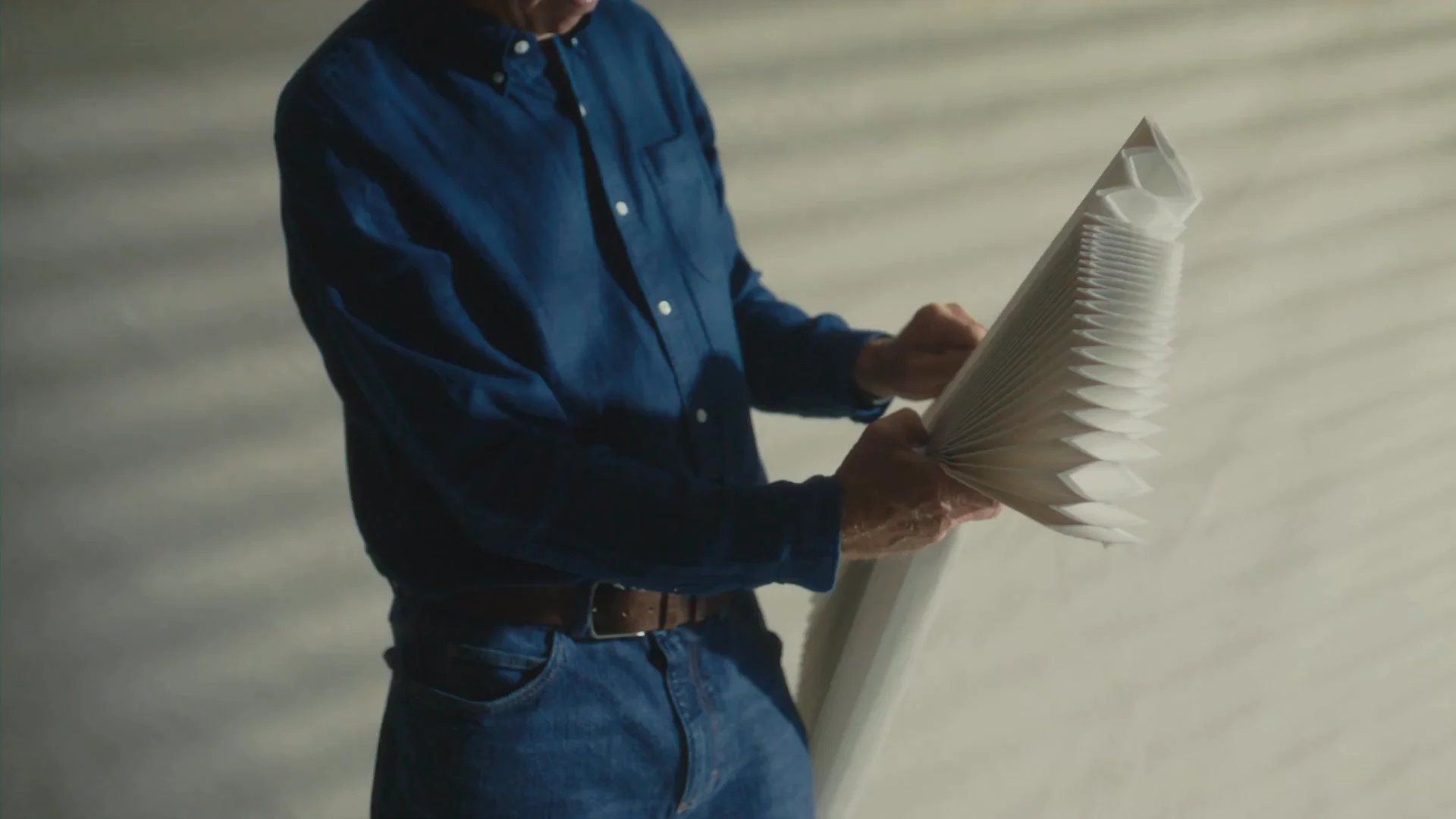
We recently visited Colson in his workspace to talk about innovation, inspiration, and the story behind an invention that changed the way people live with light. From that first drafty attic in Boston to his continued explorations today, Colson’s journey reminds us that true innovation begins with curiosity—and the determination to make life better.


Where do you think your drive to innovate comes from?
Growing up, I was a tinkering kid. Everything you could take apart, I took apart, and I built things. And then you go off to college and you have to learn something. So I said, fine—architecture. I like building things, and I was naturally a creative type.
Early on, you might not have realized just how important your tinkering would become. How did you come to understand the role of innovation—not just in design, but in addressing bigger issues?
We were in the middle of the energy crisis in the 70s and early 80s. Oil prices were way up. Jimmy Carter was coming on the TV and saying, ‘wear your cardigan sweater’ and ‘turn the temperature down in your house,’ and that really stuck with our generation. We had to find ways to save energy. And that’s what drove me to do this.

Photographed by James Stapleton
Being in New England, in the middle of winter you’d bask in the sun; at night, you froze. I thought, ‘We need something that will insulate these kinds of windows.’ The crucial piece was, how do we make movable insulation and make it better to cover sun spaces and south-facing windows? That to me was a higher call.
Your early work was all about insulation, but over time the focus expanded into light and fabric. Can you share how that shift happened?
To make insulation, we tended to make it metalized, which made it blackout. When we started to make it with translucent materials, we realized it looked pretty nice. But then, we were asked to make it in fabric, and we came up with a fabric that made the honeycomb structure. We had a two-layer cellular structure, and the way the light came through those two layers was really dramatic and really unique. We didn’t plan that. That was incidental, happenstance. Once it launched: immediate success.
People loved it and they called it ‘soft’. And our thinking was, they’re calling it ‘soft’ because it’s fabric. But the reality is, it was soft light. It was the texture of the light that came through, that felt soft. Once we understood that, we then understood we’re onto something much bigger. Those insulating double layers do something magical with light, and that was a real breakthrough.
What did you discover about the way materials could transform light?
We take fabrics and ask them to do things they naturally don’t want to do. We find that when you bend the fabric in a certain way, it develops a structure. And maybe the structure has integrity and straightness and beauty that it never had. It has a shape that you never expected. That’s the experimental process.

Photographed by James Stapleton
There’s a real emotional shift that happens when light is softened and diffused. How do you approach designing products that balance both the technical and the emotional side of light?
My office is in a house, because I need to understand the needs of individuals who live in houses. Anybody who has worked for me says, ‘Wendell will tell you, go put it up on the window and show me what it looks like.’ This is crucial. How do they look when the light comes through them? How does the color look when the light comes through them? We have to understand that, and we have to live that. If we as designers of window coverings don’t respect that, watch it, culture it, then we’re not designing the right products.
There’s one more start that’s crucial beyond anything else. It has to be beautiful. In general, our products are front and center to the house. When you walk up to a home, you see shades in the windows. If someone’s going to use our product— yes, it’s got to control the light, it’s got to give them the right softness of light, the right control to be able to do what they need to do. But if the product itself is not intrinsically beautiful, it will fail. And that’s probably the most important driver.
Can you take us inside your creative process—how you step outside the day-to-day and get into the mindset for innovation?
I think anytime you want to innovate, you have to understand what’s there. What’s out there in the world. Find out where the holes are. Where are the missing links? Where are the pieces that people might not know they need? This is a hard thing to find.
And you find it by getting out of your own box. You’re not going to design radical innovation or radical ideas sitting in a fluorescent lighted office. You’re going to design radical ideas by getting into another world, and opening your mind to what is new and different.

Photographed by James Stapleton
But ideas are very fragile. New ideas are easily squashed. It may be good, it may be bad, but you have to cultivate that idea. You have to take it and understand how to make it reality. And most of the time, for me, that’s sitting down and prototyping, saying, ‘yeah, okay, that does what I think it would do.’ But it doesn’t do that the first time. It does that the 30th time or the 50th time. And you play and you experiment with it. All of that is a really fragile process. It’s very hard to make mistakes on a regular basis and survive. And yet bringing the idea to fruition requires making 100 mistakes and one great thing.
Would you say the success of Hunter Douglas lies in nurturing ideas?
Giving individuals the freedom to take that safe space and nurture their ideas without them becoming groupthink. Groupthink often gives you more of the same. It doesn’t give you new and different.
To make great innovation, and to make great products, you have to empower your individuals to make mistakes.
I had that freedom— to make a lot of mistakes when there was no one watching me. I had that freedom to evolve things in a different way. And I think, as I developed the ability to do this within Hunter Douglas, I was able to take that freedom again and keep doing it throughout my career.

Not long after Duette went to market, you created the design for what is now known as the Silhouette Sheer Shade, among other products. How did the ideation process differ?
We were asked to build a light control version of Duette. But that isn’t actually what we needed. What we needed was not imagined yet, because light control would be, pleated shades with vanes attached… which is a really ugly thing. But it took having nothing else to do with your business partner except sit there [on a plane] and think about it in an out-of-the-box environment. All we had in was the napkins they gave us, and a pen. We drew pictures of the awful combination of a pleated shade and a Venetian blind, and then realized that the unique flexibility of the vane could create this great shape that turned out to be incredibly gorgeous.
And that was the genesis of Silhouette: written on a napkin in an airplane.

If you had to sum up the Hunter Douglas legacy in just a few words, what would it be?
It is combining design and light.
A Lasting Impact
The Duette shade wasn’t just a product—it was a response to a moment in history and a spark for future innovations. Its success paved the way for other groundbreaking innovations, from the softness of Silhouette shades and beyond. Decades later, they remain among the most iconic and most loved window treatments in the world—thanks to one man’s idea, a cold Boston winter, and a whole lot of ingenuity.
Want to learn more? Get connected below with your local Hunter Douglas expert to explore our selection of innovative window coverings.


